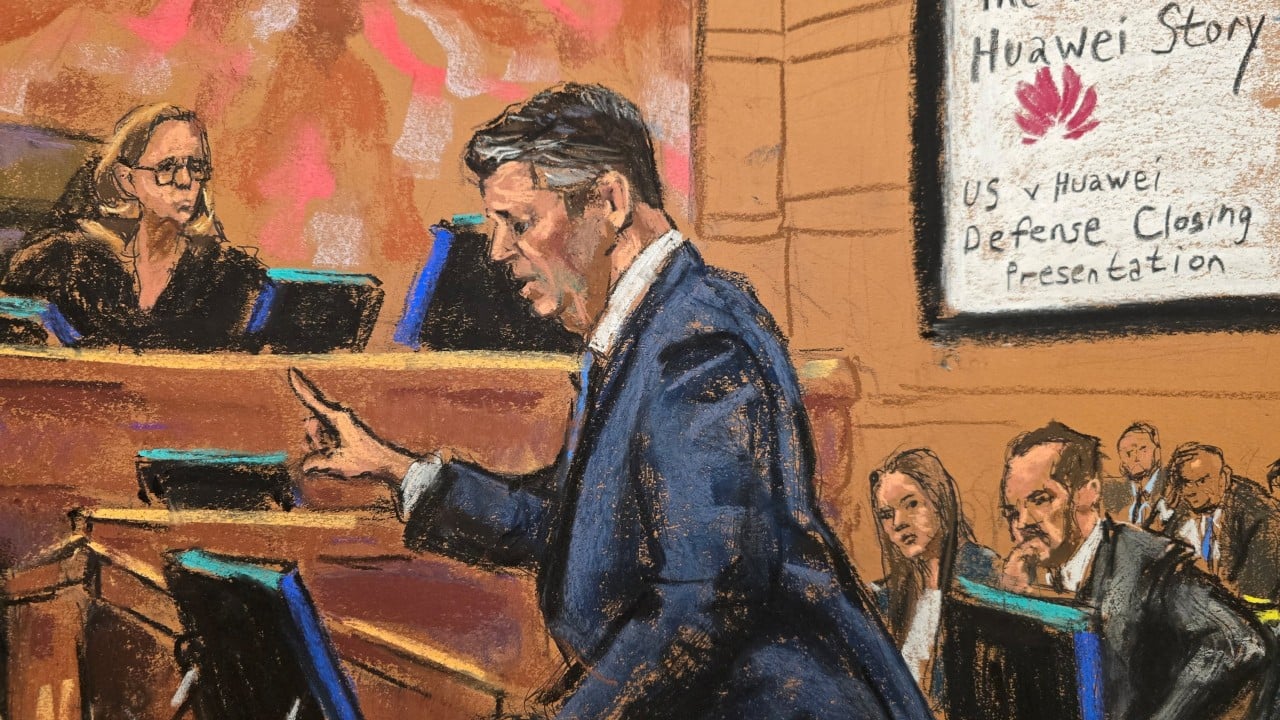
The federal courtroom in Brooklyn has spent months hosting a legal drama that feels less like a traditional white-collar trial and more like an attempt to rewrite the economic history of the twenty-first century. As closing arguments wrap up in the high-profile criminal case against Huawei, the defense hasn't just pushed back against specific charges—it has attacked the entire premise of the government's narrative. Defense lawyers didn't mince words during their multi-hour address to the court, flatly labeling the US Department of Justice's prosecution as a "fictionalised portrait" designed to criminalize ordinary corporate competition.
If you've followed this sprawling case, you know the stakes go far beyond ordinary courtroom verdicts. After nearly eight years of escalating legal confrontations, trade restrictions, and diplomatic friction, the trial forces a fundamental question: where does aggressive global business end and criminal conspiracy begin?
The Core Conflict in Brooklyn
The US government's case relies on a sweeping 12-count indictment that frames the Chinese tech giant not as a traditional innovator, but as an expansive criminal enterprise. Prosecutors argue that Huawei systematically did whatever it took to build and protect its telecommunications empire, pointing to allegations of intellectual property theft, bank fraud, and sanctions violations involving countries like Iran and North Korea. To hear the prosecution tell it, every major milestone in the company's rise was fueled by illicit behavior rather than engineering talent.
Huawei's legal team has spent the final phase of the trial systematically dismantling that thesis. In a marathon five-hour closing address, defense attorneys argued that the government took isolated incidents involving individual employees—disputes that were often resolved years ago through private civil litigation—and stitched them together into an exaggerated myth. They argued that the prosecution's story relies on twisting ordinary business operations, standard competitor rivalry, and routine international trade into sinister plots.
You don't have to look far to see why this distinction matters. When a multinational corporation invests nearly twenty percent of its massive annual revenue back into research and development—pumping billions into next-generation telecom and chip architecture—reducing that output to a blueprint for crime ignores how global technology actually scales.
Why the Prosecution's Narrative Falls Apart
The government wants jurors to believe that Huawei's technological dominance emerged entirely from stolen secrets and regulatory evasion. But real-world corporate expansion is rarely that tidy. In any global firm operating across dozens of legal jurisdictions, rogue employees occasionally cross ethical or legal lines. Major Western corporations face similar compliance scandals, internal misconduct, and regulatory fines on a regular basis without facing total enterprise eradication under racketeering conspiracy charges.
What makes the Brooklyn trial unique is the heavy geopolitical shadow hanging over the jury box. The case sits at the intersection of a broader tech war between Washington and Beijing. For critics of the prosecution, the trial looks less like an objective enforcement of American law and more like an institutional effort to handicap a foreign competitor that couldn't be contained through standard market competition.
When you look at the actual evidence presented during the months-long proceedings, the gap between the government's grandiose portrait of a sprawling criminal syndicate and the mundane reality of corporate contract disputes becomes glaring. The defense has repeatedly challenged prosecutors to show the direct corporate line connecting high-level strategy to isolated infractions, pointing instead to a severe lack of direct proof.
The Broader Reality of Global Tech Competition
We live in a marketplace where national security concerns and protectionist industrial policies frequently wear judicial robes. Whether it's restrictions on advanced AI chips, export controls, or sweeping criminal indictments, governments are increasingly using legal frameworks to police global supply chains.
Yet, treating a foundational pillar of global telecommunications infrastructure as an ordinary criminal racket creates a dangerous precedent. If every aggressive sales tactic or intellectual property disagreement between international rivals can be retrofitted into a decades-long racketeering conspiracy, the rules of global commerce change entirely.
The jury in New York now faces a monumental task. They have to decide whether the government has proven its specific criminal charges beyond a reasonable doubt, or whether they are simply buying into a dramatized narrative that mistakes fierce international competition for a coordinated conspiracy. Whatever the verdict brings, the trial has already exposed the deep friction points of a fractured global economy where technology, law, and geopolitics are permanently entangled.